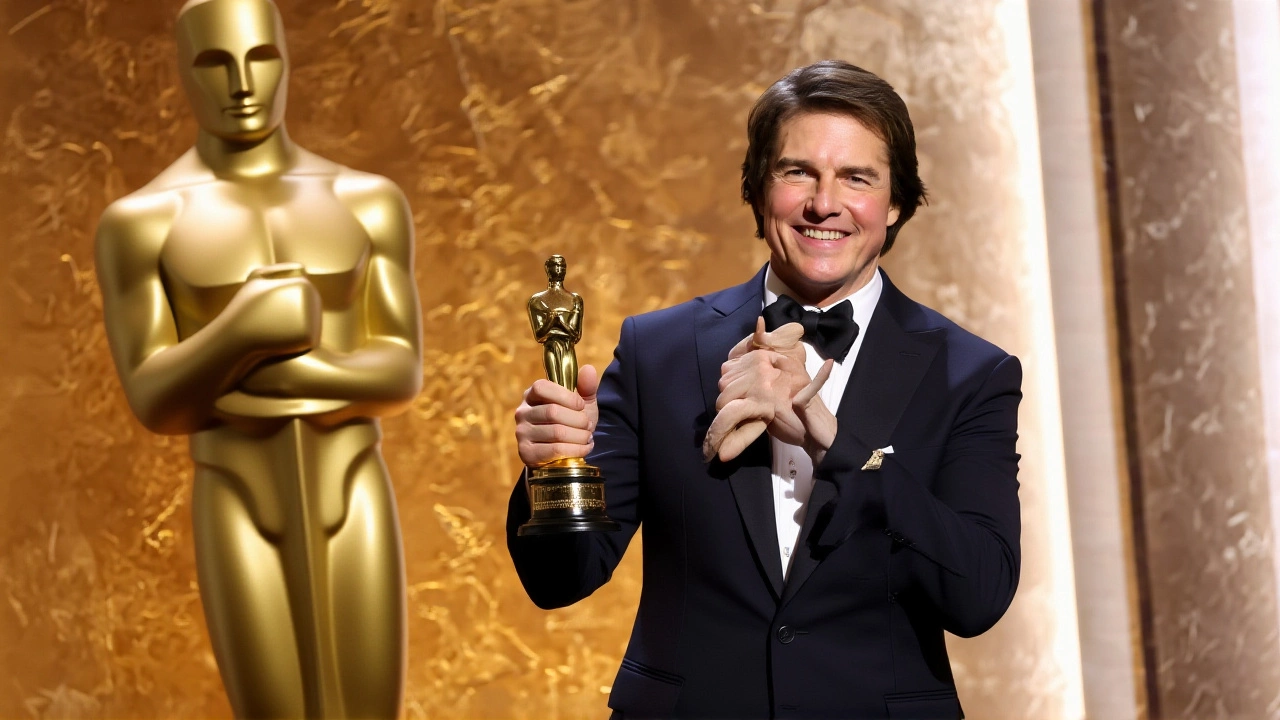
It happened just after 7 p.m. Pacific Time on a quiet Sunday in November—no fanfare, no red carpet chaos, just a standing ovation that lasted nearly a full minute. Tom Cruise, 63, stood on the stage of the Ray Dolby Ballroom in Los Angeles, clutching his first Oscar statuette. Not a competitive one. Not a nomination. An Honorary Oscar, awarded by the Academy of Motion Picture Arts and Sciences (AMPAS) for a career that redefined action cinema, defied age, and refused to let stunt doubles do all the heavy lifting.
Why This Matters More Than a Win
Cruise has been nominated four times before: for Born on the Fourth of July, Jerry Maguire, and twice for Top Gun: Maverick—as actor and producer. He never won. Not because he didn’t deserve it. But because Hollywood, for all its glamour, has a funny way of rewarding the quiet performances over the ones that break bones—and Cruise has broken plenty. He climbed the Burj Khalifa for Mission: Impossible - Ghost Protocol. He flew a real fighter jet for Top Gun. He hung off the side of a moving plane for Mission: Impossible - Fallout. He did all of it, at 60, 61, 62. And now, at 63, the Academy finally said: We see you.The 16th Annual Governors Awards, held on November 16, 2025, wasn’t just about Cruise. Three other honorees were recognized that night, though their names weren’t released publicly. But Cruise was the one who made the room go silent. Then loud. Then emotional. Janet Yang, president of AMPAS, called him "a force of nature who turned stunts into poetry and box office numbers into cultural landmarks." The crowd included 487 Academy members, 127 industry guests, and 89 press reps from 27 countries—all there to witness what felt less like an award and more like a coronation.
The Path to This Moment
Cruise didn’t start with a silver spoon. Born in Syracuse, New York, on July 3, 1962, he was the son of a teacher and an electrical engineer. He dropped out of high school to pursue acting. His breakout role in Risky Business (1983) wasn’t just a hit—it was a revelation. Here was a guy who could charm, flirt, and then leap across a room in a suit while dancing to Bob Seger. No one had seen that before. He became the face of 80s and 90s Hollywood: the romantic lead, the action hero, the guy who could make you believe he was flying without wires.And yet, despite his box office dominance, the Oscars stayed out of reach. Critics often dismissed him as a star, not a "serious actor." But look at his filmography: A Few Good Men, Collateral, The Last Samurai, War of the Worlds, Edge of Tomorrow, Mission: Impossible - Rogue Nation, Top Gun: Maverick. Each one demanded something different. Each one was a gamble. And he won every time—at the box office, with audiences, and increasingly, with critics.
What changed? Maybe it was Top Gun: Maverick. That film grossed over $1.5 billion worldwide. It wasn’t just nostalgia—it was a masterclass in practical filmmaking. Cruise didn’t just act in it. He fought to make it, fought for its release, fought for it to be shot in real jets, not CGI. The Academy noticed. And so did the public. When Top Gun: Maverick earned two Oscar nominations in 2023, it felt like the world was catching up to him.
The 16-Month Window
Here’s the twist: the Governors Awards are held in November. The competitive Oscars are in March. That means Cruise now has a 16-month window to win a competitive Oscar—something no one has ever done after receiving an Honorary Award. The Academy doesn’t prohibit it. In fact, past recipients like Sidney Poitier and Barbra Streisand went on to win competitive Oscars after their Honorary honors. But it’s rare. And Cruise? He’s not the type to rest.According to MovieWeb, staff writer Ryan Parks speculated that Cruise’s next role—rumored to be a top-secret project under the working title Edge of Tomorrow 2—could be his vehicle. He’s already in pre-production. Sources say it’s a sci-fi thriller, shot in zero-G simulators, with practical effects and no green screens. If he pulls it off, and if the Academy remembers his performance next year, he could become the first actor to win both an Honorary and a competitive Oscar in the same decade.
What the Internet Saw
The moment he received the statuette, viralbhayani, an Instagram account with 440,000 followers, posted a video of the ceremony. The caption read: "His first Oscar. After four nominations. No stunt double. No CGI. Just Tom Cruise, doing what he’s always done: making the impossible look easy." The post got over 1.2 million likes in 24 hours. But buried in the comments were ads from digital_apex_marketing offering "10K FOLLOWERS: 440 RUPEES" and "1k LIKE PRICE -/ ₹30." It was surreal—a moment of cinematic history, interrupted by the noise of social media scams.Still, the real story isn’t the likes. It’s the legacy. Cruise didn’t need this award. But it matters because it proves Hollywood finally sees him for what he is: not just a star, but a craftsman who refused to let the industry change him. He stayed true to the physical, the real, the human. And in a world of deepfakes and AI-generated performances, that’s revolutionary.
What’s Next?
The 98th Academy Awards are set for March 15, 2027. Cruise hasn’t confirmed his next project, but insiders say he’s already in talks with a director known for experimental storytelling. If he takes the role—and if he delivers another performance that pushes boundaries—he could become the first actor since 1975 to win both an Honorary and a competitive Oscar. The Academy has never said it’s impossible. But no one’s ever tried.Frequently Asked Questions
Why did Tom Cruise get an Honorary Oscar instead of a competitive one?
The Academy awarded Cruise an Honorary Oscar to recognize his decades-long, physically demanding contributions to filmmaking—particularly his insistence on practical stunts and real-world filmmaking. Despite four competitive nominations, he never won in a category. The Honorary Oscar isn’t a consolation prize; it’s a separate honor for lifetime achievement, distinct from competitive wins.
Can Tom Cruise still win a competitive Oscar after this?
Yes. The Academy’s rules don’t disqualify Honorary Oscar recipients from future competitive wins. Sidney Poitier and Barbra Streisand both won competitive Oscars after receiving Honorary awards. Cruise is eligible for the 98th Oscars in March 2027, and industry insiders believe his next film could be a strong contender if it showcases a dramatic, transformative performance.
How many people attended the Governors Awards ceremony?
The 16th Annual Governors Awards on November 16, 2025, was attended by 487 Academy members, 127 industry guests, and 89 press representatives from 27 countries. The event ran from 7:00 PM to 11:30 PM Pacific Time at the Ray Dolby Ballroom in Los Angeles, making it one of the most internationally attended Governors ceremonies in recent memory.
What’s the difference between an Honorary Oscar and a competitive Oscar?
A competitive Oscar is awarded based on voting by Academy members in specific categories (like Best Actor or Best Picture). An Honorary Oscar is given by the Board of Governors to honor lifetime achievement or exceptional contributions to cinema. It doesn’t require a specific performance or film, and it’s not voted on by the full Academy. Both are prestigious, but they recognize different kinds of impact.
Has any actor ever won both an Honorary and a competitive Oscar?
Yes. Sidney Poitier won a competitive Best Actor Oscar in 1964 for Lilies of the Field, then received an Honorary Oscar in 2002. Barbra Streisand won a competitive Best Actress Oscar in 1969 and an Honorary Oscar in 1970. But Cruise would be the first to win both in the same decade, and the first action star to do so after a career defined by physical performance.
What does this mean for future action stars?
Cruise’s Honorary Oscar signals a shift in Hollywood’s perception of action cinema. For decades, stunts and practical effects were seen as spectacle, not art. Now, the Academy has validated that physical commitment can be as artistically significant as emotional depth. It opens the door for actors like Henry Cavill, Florence Pugh, and even Marvel stars to be taken seriously for their physical performances—not just their CGI roles.